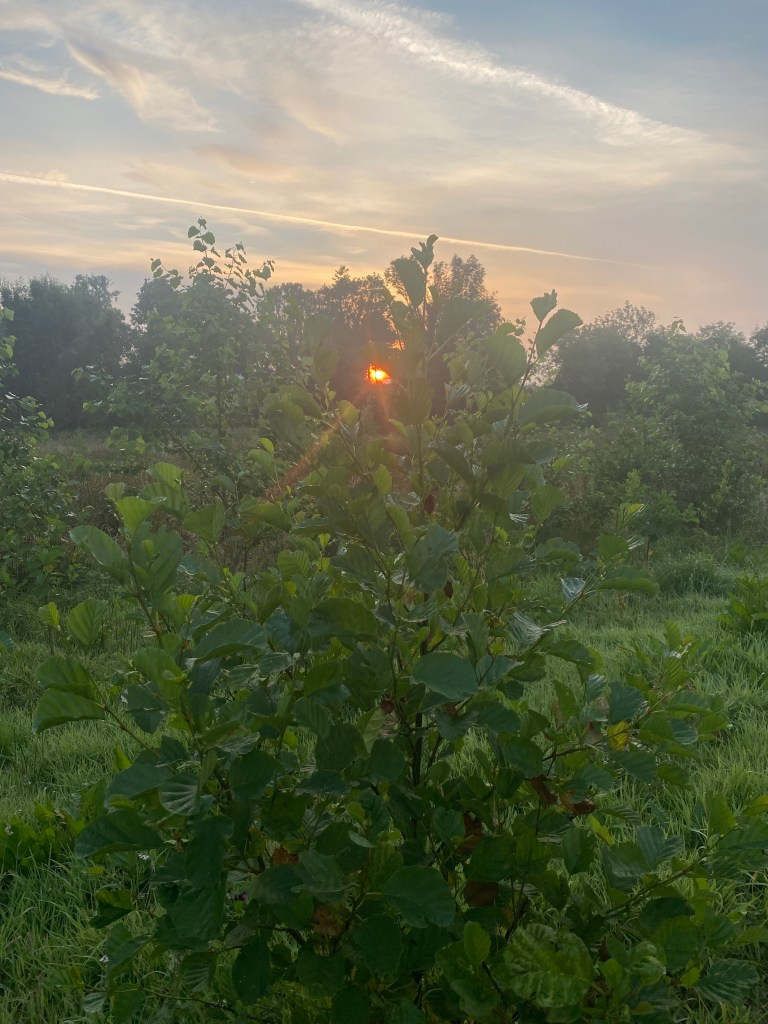
For years I misunderstood Gerard Manley Hopkins’s Pied Beauty. I thought it was a poem celebrating diversity. I don’t have permission to publish it here, but you can find it easily on the internet. It delighted in “dappled things”: skies mottled with cloud, trout whose skins were speckled, finches with piebald wings, fields “plotted and pieced”. It seemed to be saying that the world is beautiful because it contains such astonishing variety.
I still think the poem celebrates variety. I just no longer think that is what it is about. The older I become, the more I suspect that Hopkins was asking something much harder of us. He was inviting us to see.
That sounds absurdly simple until one begins to think about it. We spend much of our lives recognising things rather than seeing them. We identify a bird, classify a flower, label a tree. We become remarkably efficient at placing the world into categories.
Categories are useful. We could scarcely manage without them. Science depends upon them. Libraries would be impossible without them. Every conversation relies upon words that gather countless individual things into a single name. The difficulty begins when we mistake the category for the thing itself.
Once we have recognised something, we often imagine that we have finished looking. Hopkins never allows us that luxury. His trout are not examples of a species. His skies are not illustrations of weather. His fields are not simply agricultural landscapes. Every image in Pied Beauty feels stubbornly particular, as though he wanted us to notice not merely what a thing is, but that it is. Perhaps this explains why the poem has never grown old. It resists abstraction. It keeps returning us to the world itself.
When I discovered that Hopkins had been deeply influenced by the medieval Franciscan philosopher John Duns Scotus, things started to make sense. Scotus used the Latin word haecceitas, usually translated as “thisness”, to describe the irreducible uniqueness of every created thing.
It is one of those philosophical terms that sounds more complicated than the idea itself, but we can think of it this way. There is no such thing as “a tree”. There is only this ash leaning into the wind, this alder catching the morning light, this hawthorn shaped by years of Atlantic weather. The words we use arrive centuries after the reality evolved. A thing has being before anyone gives it a name.
I sometimes wonder whether this is what we risk losing in our age of extraordinary classification. We sort, organise, analyse and measure with astonishing sophistication. We have become adept at describing populations, trends and identities. Yet there are moments when I wonder whether our increasing ability to classify has come at the expense of our ability simply to attend.
The temptation is not merely to organise the world. It is to believe that once we have organised it, we have understood it.
The same temptation extends to people. It is easier to meet a category than a person. We encounter professions before personalities, opinions before faces, identities before names. We become fluent in description while slowly forgetting acquaintance.
Hopkins offers another possibility. He asks us to look long enough for the thing before us to become itself again. That, I suspect, is why Pied Beauty ends in praise rather than explanation. Praise begins where possession ends. It asks nothing of the world except that it should be allowed to be what it is.
Perhaps seeing has always been less about looking harder and more about resisting the urge to look away too soon.
This summer morn.
Cycloptic cloud
grazes
the vermilion dawn.
First light
finds
young alder.
First bird
stirs
unseen.
This cloud
will pass.
This sun
will climb.
This.
Amen.


Leave a Reply