I was reading the summer edition of The Irish Garden recently when I came across a feature written by Colin Stafford-Johnson. Many people will know him from The Wild Gardener, in which he returned to his childhood garden and began creating a place for native plants and wildlife. In the feature, he mentioned an old Irish saying: the thorn and the oak are friends. The sentence had the compact strangeness of an old proverb. It seemed simple enough, yet I found myself continuing to think about it.
Colin recalled clearing brambles from around young native trees in his garden. He believed he was giving them room to grow. Once the brambles were gone, however, deer came and ate the saplings. The thorns had hidden them from view. What appeared to be neglect had been a form of protection.
My own land has been teaching me something similar. Six years ago, I planted a number of alders. Some remained visible and grew in the open. Others gradually disappeared beneath the brambles. For several summers, I saw only the occasional leaf or slender branch among the thorns. I assumed that these trees were struggling and wondered whether I should clear the ground around them.
I left them alone, partly through uncertainty and partly because there was always something more urgent to be done. Over time, the alders began to emerge. They are now among the strongest trees on the land. Their trunks have thickened inside the brambles and their branches have found their way towards the light. Several of the young oaks remain hidden. I know where they are because I remember planting them, and when I look closely, I can see their leaves among the thorns. They appear to be making their way slowly upwards.
It is difficult to look at a young tree almost lost among brambles and not imagine the ground cleared around it. I want to see the trunk, measure its growth and reassure myself that the tree is still there. The tangle conceals too much. Yet the alders seem indifferent to my preference for order. They have grown according to another arrangement, one in which shelter and obstruction are not so easily separated.
I have begun to wonder whether a human life may be like this too. I often see obstacles and imagine that, once they have been removed, the way ahead will become clear. Yet my life is not an ornamental garden. It is closer to an ecosystem. The period that appears unproductive may be allowing some quieter understanding to take root. What restricts me in one direction may be turning me gently towards another. Often it is only much later that I understand the difference between what was holding me back and what, without my recognising it, was holding me.
The image cannot be made to carry everything. Brambles sometimes overwhelm what grows among them, just as there are circumstances in which survival depends upon finding a way out. I do not want to turn every difficulty into a hidden kindness. Perhaps the old saying asks for something more modest: a willingness to look twice.
My relationship with the land has changed over the past six years. In the beginning, I saw it largely as a series of tasks. There were trees to plant, brambles to clear and some sort of order to establish. I am more hesitant now. I am beginning to understand how much can happen without my direction.
Last Sunday morning, after rain had finally come to the west of Ireland, I looked out over the half door as it began to ease. A cock pheasant was making his way slowly up the lane. I have grown rather fond of him. I have no proof, but I suspect he has a number of wives living in the ditch, a domestic arrangement he seems to regard as entirely unremarkable. I watched him leave the lane and disappear into the long grass. At first, I thought the pleasure of the moment lay in having seen him. Afterwards, I wondered whether it lay just as much in the fact that he could disappear. A living place is not only somewhere a wild creature may appear. It must also offer cover from our gaze. For a few moments, the pheasant belonged to the part of the land I could see. Then the long grass took him back, and the land resumed keeping some of its life to itself.
I recognised something of myself in his disappearance. The solitude of the cottage offers me a similar kind of cover. Here, away from the expectations of others and from my own tendency to examine experience too closely, not everything has to be brought immediately into the light. A thought can remain unfinished and a life need not be continually explained. I do not always enter solitude in search of clarity. Sometimes I need simply to pass beyond view for a while. Perhaps all of us need somewhere that releases us from the pressure of being watched, interpreted or understood, even by ourselves. The pheasant had not disappeared from the world when he entered the grass. He had only entered a part of it where I could no longer follow.
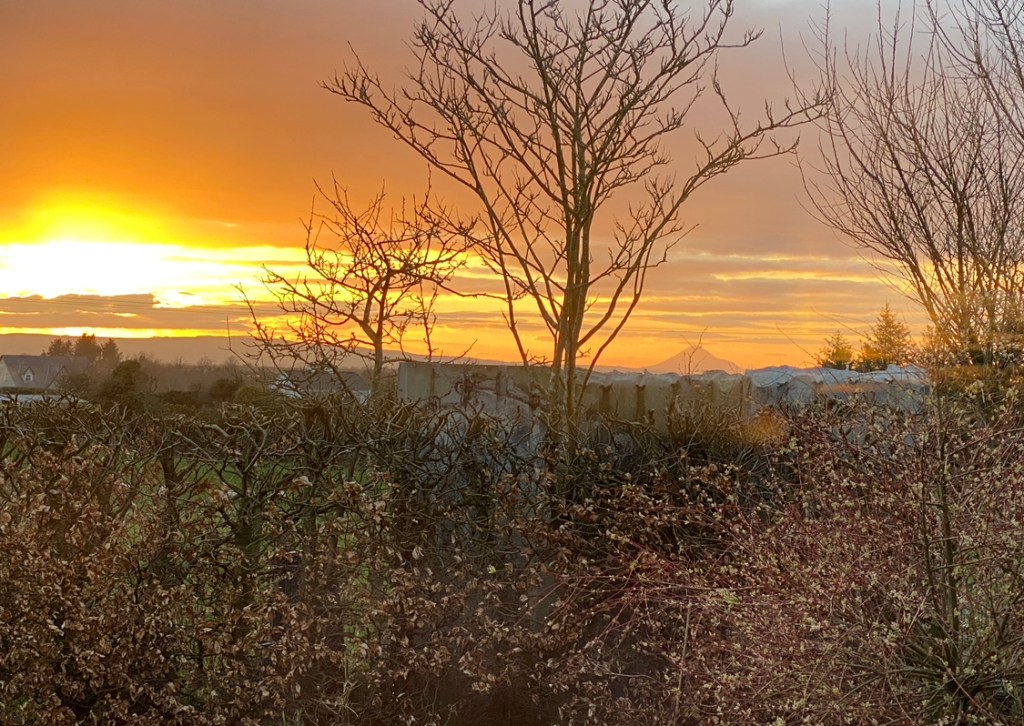
Here, at the height of summer, I find myself remembering a photograph I took last winter as I walked the lanes beyond my cottage. There, rising above the brambles, was a tree. The low winter sun was setting, and Croagh Patrick could be seen far in the distance. At the time, I thought the photograph was about the fading light and the mountain on the horizon. Looking at it now, I see the foreground differently. The brambles no longer seem simply a dark mass beneath the tree. They have become part of the story of how it came to stand there. I had thought the tree was escaping them. Now I wonder whether, for a time, they had allowed it to grow unseen.


Leave a Reply